Jay
Garrulus glandarius
Caróg liath
Status: Local resident in broadleaf woodland throughout Ireland.
Conservation Concern: Green-listed in Ireland. The European population is considered to be Secure.
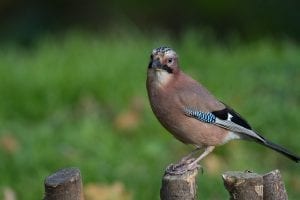
Identification: Unmistakable. Probably one of the most colourful and striking birds breeding in Ireland. About the same size as a Jackdaw, with ages and sexes similar in apearance. The body is pale brown, with some dark streaking on the crown. A black stripe extends from the base of the bill to the neck. The throat is white. In flight, shows large patches of blue and white on the otherwise black wings. Also, has a large white rump which contrasts markedly to the black tail. The flight action is rather weak and fluttering.
Similar Species: No other Crow species has similar colouring.
Call: Presence most frequently revealed by its loud voice. The most frequently heard is a loud “haasch –haasch”. Other calls include an expert mimicry of the Buzzards mewing call. The song is quiet and rarely heard.
Diet: Omnivorous - including seeds, insects, and less frequently young birds and eggs. In autumn, caches large numbers of nuts (beech, oak, hazel) for use during the winter and is able to remember the location of these caches with a high degree of accuracy.
Breeding: Jays mainly breed in deciduous woodland and to a lesser extent in coniferous forests. Jays in Ireland tend to be significantly shyer and more elusive than those found in Britain and the Continent, and are only rarely seen in suburban gardens.
Wintering: Resident within their territory throughout the year. In autumn, Jays will gather and store large amounts of acorns and other large seeds for consumption during the winter.
Where to See: Widespread in Ireland. The oak forests in the Vale of Avoca around Laragh and Glendalough hold good numbers of Jay.
Monitored by: Countryside Bird Survey.