Ireland's winter thrushes
Over the past couple of weeks BirdWatch Ireland has received an unprecedented number of phone calls and emails about unusual "thrush-like birds" foraging in gardens and on roadside verges. These are Redwings and Fieldfares, members of the thrush family that visit Ireland each winter. The harsh weather seems to have driven them to seek refuge closer to our homes, and numbers appear to have been boosted dramatically by refugees from the continent.
Though superficially similar to Song Thrush and Mistle Thrush, familiar year-round visitors to Irish gardens, Redwings and Fieldfares have a number of very distinctive plumage features that make identification quite simple when you know what to look for.
Redwing
A widespread winter migrant, the handsome Redwing is a regular sight across Ireland, though numbers this winter seem much higher than usual. Most of our visitors are from the population that breeds in Iceland, though some also come to us from Scandinavia.
Named for the striking rusty-red colour under its wings, when perched the only red visible on the Redwing is along its flanks. At 21cm, it is a little smaller than its more familiar relative the Song Thrush, and like that species it has brown upperparts and a heavily spotted breast. The Redwing’s spots are denser and more streaky however, and it is also easily distinguished by the pale stripe under each cheek and over each eye: no other Irish thrush shows this distinctive facial pattern.
Fond of berries, particularly those of Hawthorn, Rowan and Cotoneaster, Redwings also readily devour earthworms; flocks can frequently be seen digging for these on grassy areas. They are also very partial to apples, which make an ideal garden food for them in cold weather.
.jpg)
A Redwing standing in a typical posture on a snowy lawn: note particularly the cream-coloured stripe above the eye and the obvious reddish colouration one the side of the body
(Photo: Dick Coombes)
.jpg)
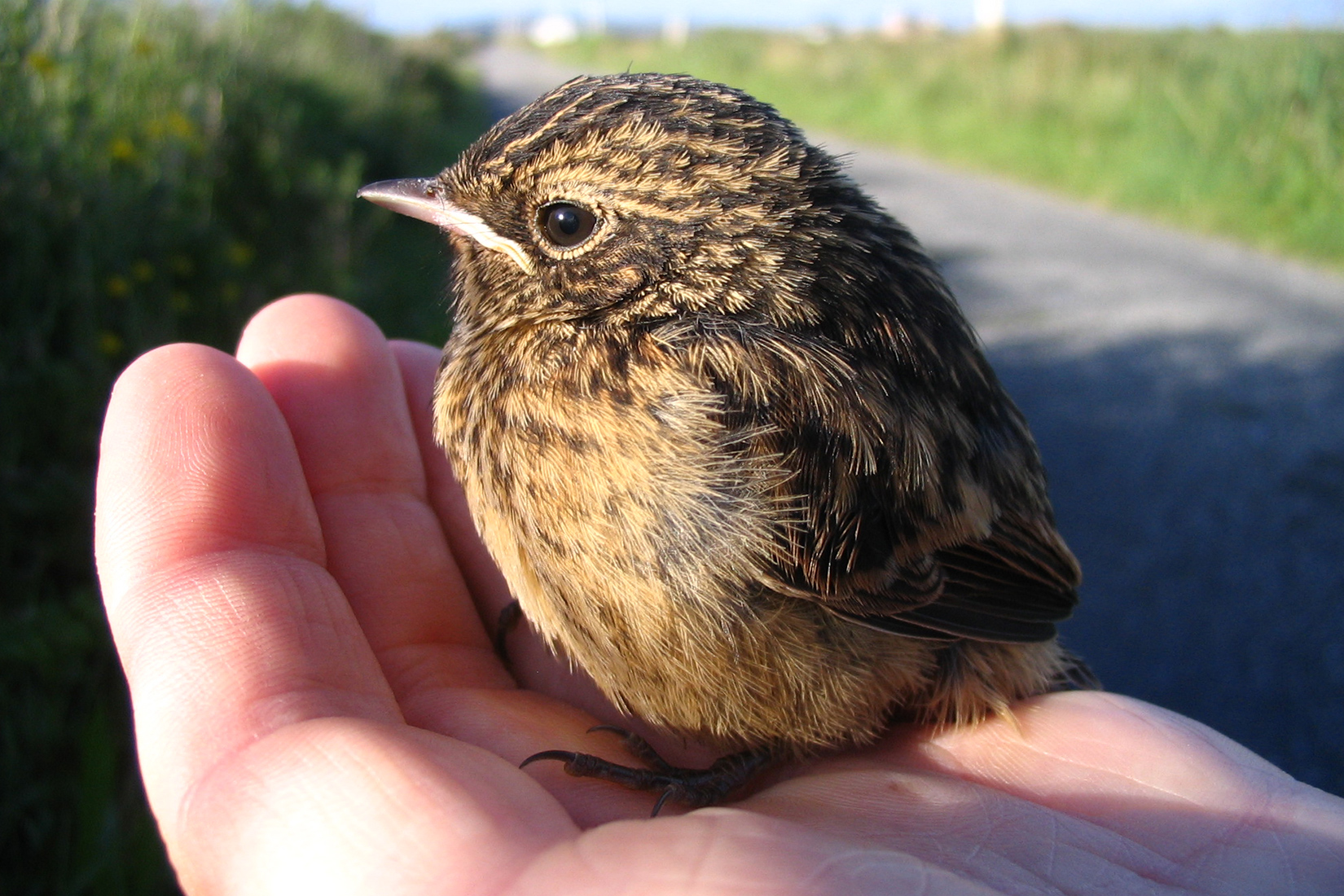
A rehabilitated Redwing in the hand, showing this species' distinctive facial pattern very well. Note also the typical black and yellow colour of the bill.
(Photo: Fiona van Dokkum)
.jpg)
The same rehabilitated Redwing, showing the extensive reddish colouration under the wing and on the side of the body.
(Photo: Fiona van Dokkum)
Fieldfare
Only slightly smaller than its more familiar cousin the Mistle Thrush, at 26cm, the Fieldfare is a large, stocky thrush that often forms mixed feeding flocks with Redwings and other thrushes. They come from Scandinavia and central and eastern Europe to spend the winter in Ireland, and they tend to be quite dominant towards other thrush species.
The distinctive grey head and rump of the Fieldfare make it easy to identify if seen well, as they contrast quite strongly with the chestnut back and wings, but note also the very dense black chevron markings on the breast and flanks. The upper breast also has a distinctly yellow-orange wash, while the belly is white and unstreaked. The bill is predominantly yellow.
As with other thrushes, Fieldfares feed mainly on worms and berries, though during hard weather they will happily eat a range of fruit: as with Redwings, apples are a particular favourite. They can usually be distinguished from Redwings at a distance by their larger size and more upright posture, though be aware that Mistle Thrushes can look similar in this respect.
.jpg)
A Fieldfare in typical pose, with the grey head and heavily marked breast and flanks showing well
(Photo: Billy Clarke)
.jpg)
The extensive grey rump is visible on this perched Fieldfare: note the contrast with the brown back and wings. Note also the fondness for apples.
(Photo: Dick Coombes)
.jpg)
A Fieldfare in a huddled posture, trying to stay warm. The yellow-orange ground colour of the breast and the striking contrast between the grey head and brown back are very evident in this photo. Note also the white unstreaked belly and the predominantly yellow bill.
(Photo: Dick Coombes)
Comparison species: Mistle Thrush and Song Thrush
Common year-round visitors to gardens across Ireland, these Mistle Thrush and Song Thrush are more likely to be confused with each other than with either Redwings or Fieldfares if seen well. With distant views, however, some confusion can arise. Confusion with our fifth winter thrush species, the familiar Blackbird, is much less likely.
The Mistle Thrush is roughly the same size as the Fieldfare, and it shares its typical long-necked "alert" posture. Unlike that species, however, the head, back and rump are all uniformly brown, and there is no yellow-orange tone on the breast. The dark marks on the underparts take the form of round spots rather than pointed chevrons, and these markings extend further down onto the belly. The bill is also generally darker.
.jpg)
Mistle Thrush: note the upright stance, the uniform colour of the head, back and rump and the round shape of the spots on the breast and belly.
(Photo: Billy Clarke)
The Song Thrush is a noticeably smaller bird than either the Mistle Thrush or the Fieldfare, though it is marginally larger than the Redwing. It can easily be told from this latter species, however, by the lack of strong facial markings, and particularly the absence of any pale stripe above the eye. It also lacks any red colouration on its sides. It is often confused with the Mistle Thrush, but note the much smaller size, the warmer brown colouration on the upperparts and the more short-necked appearance. The shape of the spots on the underparts are also a good identication feature: round on a Mistle Thrush but more pointed at the top on a Song Thrush, looking almost like upside-down heart shapes.
.jpg)
Song Thrush: note the lack of any stripe above the eye, the uniform warm brown upperparts and the pointed, not round, spots on the underparts.
(Photo: Michael Finn)
For completeness, the Blackbird, our best-known thrush and one of Ireland's most familiar garden birds, also deserves a mention. The male Blackbird, with his completely black plumage and bright yellow bill and eye-rings, usually poses no identification challenge; note, however, that males younger than one year of age often have a much darker bill.
The dark brown female usually, though not always, shows a duller bill and eye-rings than the male, and although some streaking is often visible on her breast, she is always much darker than any of the other thrush species that visit Irish gardens in the winter.
.jpg)
Male Blackbird: the all-black plumage and yellow bill and eye-ring make this common and familiar thrush unmistakable
(Photo: Jerry Cassidy)
.jpg)
Female Blackbird: note the dark brown, not black, plumage and the faint streaking on the throat and upper breast. Given good views, female Blackbirds should always appear much darker overall than any of our other winter thrush species
(Photo: Neil van Dokkum)